

Search Description: Pakistan host England and Sri Lanka in the ODI tri-series, October 18-31. Squads, full schedule, key battles, 2027 World Cup stakes and my prediction.
Pakistan ODI Tri-Series 2026: Squads, Schedule, Key Battles and My Winner Prediction
By NajamSports Team | October 17, 2026
The trophy was unveiled in Rawalpindi today. Shaheen Shah Afridi, Harry Brook and Kusal Mendis stood together with it at the Rawalpindi Cricket Stadium this afternoon, smiled for the cameras, and said the usual polite things about respecting the opposition. Tomorrow, the politeness ends. Pakistan take on Sri Lanka in the opening match of the KFC Presents Bank Alfalah ODI Tri-Series, and for the next two weeks, this is the only 50-over cricket that matters.
I have been waiting for a series like this. Not a bilateral where one dead rubber kills the mood by the third game, but a proper three-team fight — seven matches, two cities, top two reach the final. Pakistan, England, Sri Lanka. Full-strength Pakistan. An experimental but dangerous England. A wounded Sri Lanka with nothing to lose. If you love ODI cricket, clear your evenings from tomorrow.
This is my deep dive: every squad, the full schedule, the players I will be watching, the battles that will decide it, what it means for the 2027 World Cup — and at the end, my honest prediction. Not a safe "anyone can win" cop-out. A real pick, with reasons.

Rawalpindi Cricket Stadium — the tri-series begins here tomorrow. File photo, Wikimedia Commons (CC BY-SA 4.0)
What Happened?
Here is the frame, all confirmed. The tri-series runs October 18 to October 31 — seven matches, all day-night. The first three are in Rawalpindi (1:00 PM starts), then the tournament moves to Lahore's Gaddafi Stadium for the last three league games and the final (12:00 noon starts). Each team plays the other two twice, and the top two on the table meet in the final on October 31.
England landed in Islamabad yesterday (October 16) — a 33-member touring party with a 16-man squad — and trained at Rawalpindi today from noon. Pakistan and Sri Lanka have been training since Thursday. The captains did their press conferences today alongside the trophy unveiling. Everything is in place. No more talking.
Full Schedule — Pakistan ODI Tri-Series 2026
- October 18 (Sunday): Pakistan vs Sri Lanka — Rawalpindi Cricket Stadium, 1:00 PM
- October 20 (Tuesday): Pakistan vs England — Rawalpindi Cricket Stadium, 1:00 PM
- October 22 (Thursday): Sri Lanka vs England — Rawalpindi Cricket Stadium, 1:00 PM
- October 25 (Sunday): Pakistan vs England — Gaddafi Stadium, Lahore, 12:00 PM
- October 27 (Tuesday): Pakistan vs Sri Lanka — Gaddafi Stadium, Lahore, 12:00 PM
- October 29 (Thursday): Sri Lanka vs England — Gaddafi Stadium, Lahore, 12:00 PM
- October 31 (Saturday): FINAL (top two teams) — Gaddafi Stadium, Lahore, 12:00 PM
One small thing worth knowing: this is Sri Lanka's first bilateral limited-overs series in Pakistan since 2019. That tells you how rare — and how welcome — this kind of cricket is.

Gaddafi Stadium, Lahore — hosts the final on October 31. File photo, Wikimedia Commons (CC BY-SA 4.0)
Pakistan — Full Strength, and the Favourites Tag They Did Not Ask For
Squad: Shaheen Shah Afridi (c), Abrar Ahmed, Salman Ali Agha, Arafat Minhas, Babar Azam, Faheem Ashraf, Fakhar Zaman, Muhammad Ghazi Ghori (wk), Haris Rauf, Hasan Nawaz, Naseem Shah, Razaullah, Saad Baig (wk), Saim Ayub, Shadab Khan, Sufiyan Moqim.
Let us start with the obvious: Pakistan have picked their best sixteen. No experiments, no resting seniors, no "building for the future" talk. Shaheen leads, Babar is there, Fakhar is there, the full pace battery is there. At home, against two teams that both have holes, Pakistan should win this. And that "should" is exactly what makes me nervous — because Pakistan teams and "should" have a complicated history.
Babar Azam turned 32 this week. I keep thinking about what that means. This is no longer the young genius — this is a senior pro in his prime years, and his ODI record against England (that 158 at Birmingham in 2021 still the highest by a Pakistani against them) says he owns this opposition. If Babar has a big series, Pakistan probably reach the final. It really is that simple.
The question I cannot stop turning over is the wicketkeeper. Muhammad Ghazi Ghori or Saad Baig? Baig just earned his maiden ODI call-up after stacking up more than a thousand Quaid-e-Azam Trophy runs — you do not hand a kid that call-up and then not look at him. But Ghori has been around the squad longer. Mike Hesson has a decision to make, and with the 2027 World Cup fifteen starting to take shape in selectors' minds, every keeper's innings in this series is an audition. I would play Baig in at least two of the four league games. You called him up — now find out what he is.
Then there is Razaullah. Raw pace, the kind that makes batters hop. Hesson said something this week that stuck with me — that Kusal Mendis, who plays pace as well as anyone in Sri Lanka's lineup, "got done for pace" by Razaullah in the nets, and that new bowling coach Shaun Tait is now working with him on his lengths. That is the whole story of young fast bowling in one line: the pace is a gift, the lengths are the job. If Tait gets the lengths right by the Lahore leg, Razaullah could be the breakout star of this tournament.
The spin department quietly excites me more than the pace. Abrar Ahmed, Shadab Khan, Sufiyan Moqim — three very different spinners, and Lahore in late October will grip. England's middle order against quality spin, under lights, in front of a Lahore crowd — that is a contest I am genuinely looking forward to.
One honest footnote: Mohammad Rizwan is not in this squad, with the NCCIA probe still hanging over him. I am not going to speculate beyond what is reported — but his absence is the reason the keeper debate exists at all, and it is the subtext of every selection in this series.
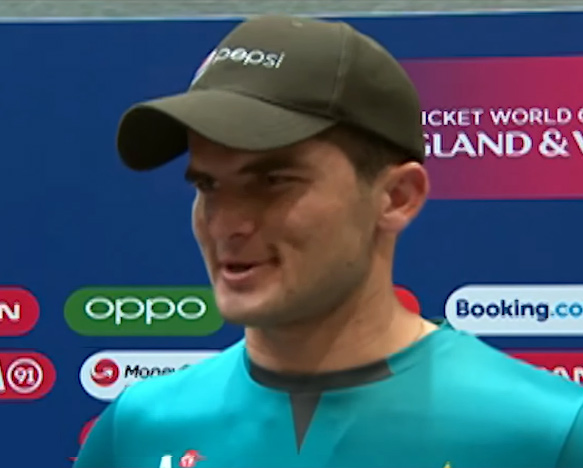
Shaheen Shah Afridi — Pakistan's captain and new-ball spearhead. File photo, Wikimedia Commons (CC BY 3.0)
England — The Experiment That Could Win the Whole Thing
Squad: Harry Brook (c), Gus Atkinson, Sonny Baker, Tom Banton, James Coles, Jordan Cox (wk), Mason Crane, Henry Crocombe, Sam Curran, Liam Dawson, Ben Duckett, Will Jacks, Jamie Overton, Adil Rashid, Joe Root, Josh Tongue.
Here is what I love about this England squad: it is missing Jos Buttler (hamstring surgery), Jofra Archer (rested) and Jacob Bethell (knee) — three first-choice players — and it still looks dangerous. That tells you where England's white-ball depth is right now.
Harry Brook captains, and he has earned the right to be taken seriously: under him, England have won their last three ODI series — at home to Sri Lanka and India, and away in Sri Lanka just last month, where they won the decider by 223 runs (355 for 7 against 132 — a proper hammering). A young captain on a winning run is a dangerous thing.
Joe Root is the anchor. In a squad full of hitters and hopefuls, Root is the man who makes sure 280 does not become 230. I have watched Root bat in Asia for a decade — he sweeps, he nurdles, he never panics against spin. On Lahore's turning tracks, he might be England's most important player.
And then Adil Rashid is back — hand injury healed. I am going to say this plainly: Rashid's return is the single biggest X-factor of this series. A world-class leg-spinner, in Asian conditions, against batters who grew up facing spin but still have to pick his googly under lights. The Babar-versus-Rashid battle alone is worth the ticket.
Sam Curran is back too (groin recovered), and Jordan Cox keeps wicket after that 76 off 52 in the Sri Lanka series decider at The Oval. But the names that fascinate me are the three uncapped players: Mason Crane (29, leg-spinner, first England call-up in the better part of a decade — imagine waiting that long), Henry Crocombe (21, genuinely quick) and James Coles (22, all-rounder). They are not here for the experience. They are here because the 2027 World Cup squad has empty chairs, and this is their interview.
England's gamble is clear: blood the kids, trust the system, keep winning. It has worked for three series. Pakistan at home is the first real test of it.

England in ODI action — Brook's side arrive on a three-series winning streak. File photo, Wikimedia Commons (CC BY 2.0)
Sri Lanka — Backs Against the Wall, and That Makes Them Dangerous
Squad: Kusal Mendis (c, wk), Lahiru Udara, Avishka Fernando, Kamil Mishara, Pavan Rathnayake, Sahan Arachchige, Kamindu Mendis, Janith Liyanage, Dasun Shanaka, Dunith Wellalage, Maheesh Theekshana, Sachindu Colombage, Dushmantha Chameera, Asitha Fernando, Dilshan Madushanka, Eshan Malinga.
I will not sugarcoat it: Sri Lanka arrive as the third favourites, and they know it. Pathum Nissanka — their best white-ball opener — was ruled out two days ago after failing to get medical clearance for the hamstring injury he picked up on the England tour. He missed the T20Is against Pakistan too, so this is now a month without their most reliable source of powerplay runs. That is a genuine blow, not a media narrative.
His replacement, Lahiru Udara, has never played an ODI. Let that sit for a second: Sri Lanka's answer to losing Nissanka is a 31-year-old domestic stalwart with 3,017 List A runs at 32.09 — solid, unspectacular — whose biggest international moment remains the 91 he scored against Pakistan in the first T20I last week. I actually like this story. Udara has waited his whole career for a door to open; it just opened. Whether he walks through it against Shaheen's new ball in Rawalpindi is another question entirely.
The rest of the absentee list is just as stark: Charith Asalanka DROPPED (19 runs in his last three ODI innings — 1, 11, 7 — and even an average of 40.55 across 88 ODIs could not save him), Wanindu Hasaranga out injured. Avishka Fernando is recalled having not played an ODI since February 2025, and Sahan Arachchige comes in for Hasaranga.
So what do Sri Lanka actually have? Kusal Mendis captaining and keeping — their best batter, and a man who has made a career of standing up when the team is written off. And spin: Maheesh Theekshana and Dunith Wellalage are a genuinely good pair, the kind that can defend 240 in Lahore. Dasun Shanaka brings experience and late-order hitting. And they took the third T20I off Pakistan last week, so they know they can beat this opposition.
My honest read: Sri Lanka will not win this tournament. But they will ruin somebody's week. In a six-match league where net run rate and one bad day decide the final, the wounded team is the one you fear most.
Players to Watch — My Ten Names for the Fortnight
Every tournament has players you plan your evening around. Here are mine — the ten I will be watching closest, and why.
Babar Azam (Pakistan). He turned 32 two days ago, and I keep coming back to a simple thought: great players define eras in their early thirties. Babar's ODI game — the cover drive, the calm against spin, the way he builds an innings without ever looking rushed — is made for these conditions. His 158 against England at Birmingham in 2021 remains Pakistan's highest individual ODI score against them. If he bats through once in Rawalpindi, Pakistan win that game. It really is that straightforward.
Shaheen Shah Afridi (Pakistan). The captain, the new-ball weapon, the man the crowd comes to see. Shaheen's first spell sets Pakistan's tone — when he swings it early, the whole team walks taller. Captaincy adds a layer: how he rotates his quicks, when he brings himself back, how he handles the dew. I am watching the captain as much as the bowler.
Fakhar Zaman (Pakistan). The most dangerous kind of batter — the one who can end your plans in the powerplay. Fakhar does not accumulate; he detonates. Against Sri Lanka's new-ball pair tomorrow, the first ten overs could decide the opener. If Fakhar is still there at the 15-over mark, start worrying if you are Sri Lanka.
Razaullah (Pakistan). My breakout pick. Genuine pace is the rarest currency in cricket, and Pakistan may have minted a new note. Shaun Tait working on his lengths is the story within the story — Tait was himself a slingy tearaway who learned control late. If the student learns fast, batters across all three teams are in trouble.
Harry Brook (England). Twenty-seven, captaining a winning machine, playing with the freedom of a man who has never known failure at this level. Brook's captaincy will be tested the first time Pakistan's quicks have England 40 for 3. How he responds — with a counterattack or a rebuild — tells us what kind of leader he is becoming.
Joe Root (England). In a squad of hitters, Root is the adult in the room. His game against spin — the sweep, the late dab, the refusal to panic — is exactly what England will need in Lahore. I have a feeling one Root hundred in this series decides a match England had no business winning.
Adil Rashid (England). The X-factor, full stop. A 38-year-old leg-spinner returning from injury to bowl in Asia — this is either a masterstroke or a gamble, and I lean masterstroke. Rashid has spent a career outfoxing batters who grew up on spin. Under Lahore lights, against Pakistan's middle order, he could be unplayable.
Kusal Mendis (Sri Lanka). Captain, keeper, best batter, last man standing. Mendis has made a career of defiance — and with Nissanka gone and Asalanka dropped, Sri Lanka's hopes rest almost entirely on his shoulders. The great Sri Lankan captains were forged in exactly these circumstances. This is his forging.
Lahiru Udara (Sri Lanka). No ODI cap. Thirty-one years old. Called up because the star got injured. Udara's story is every domestic cricketer's dream and nightmare at once — the chance of a lifetime, against Shaheen Shah Afridi, in Rawalpindi, tomorrow. I will be watching his first ten balls more closely than almost anything else in the opener.
Maheesh Theekshana (Sri Lanka). Mystery spin remains cricket's great equalizer. Theekshana's variations — the carrom ball, the pace changes — are designed for exactly these slow, gripping surfaces. If Sri Lanka defend a low total anywhere in this tournament, he will be the reason.

Babar Azam — turned 32 this week, and Pakistan's biggest batting hope. File photo, Wikimedia Commons (CC BY 3.0)
Five Battles That Will Decide the Series
1. Shaheen and Naseem's new ball vs Brook, Root and Duckett. This is the heavyweight fight. Pakistan's opening burst — Shaheen swinging it in, Naseem seaming it away, Haris hitting the deck — against England's top three. If Pakistan take two in the first ten overs, England's young middle order walks into pressure. If Brook and Duckett survive the new ball, Pakistan's spinners inherit the problem. Everything flows from the first hour.
2. Babar Azam vs Adil Rashid. I am calling this the connoisseur's battle. Babar is Pakistan's best player of spin; Rashid is the best leg-spinner in this tournament. Middle overs, Lahore, under lights. Babar's 158 at Birmingham in 2021 tells you he does not fear England — but Rashid's googly has ended better plans than his. Whoever wins this mini-duel probably wins their team's biggest game.
3. Pakistan's spin trio vs Sri Lanka's middle order. Abrar's mystery, Shadab's experience, Sufiyan's left-arm angles — against Mendis, Kamindu Mendis and Shanaka. Sri Lanka without Nissanka cannot afford a top-order collapse, which means their middle order will face Pakistan's spinners with the game on the line. In Rawalpindi's first game tomorrow, this is where I expect the match to turn.
4. Fakhar Zaman and Saim Ayub vs Chameera and Madushanka. Pakistan's powerplay intent against Sri Lanka's new-ball pair. Fakhar on his day ends contests in six overs; Saim is the future. But Chameera has genuine pace and Madushanka swings it. If Sri Lanka are going to cause the upset tomorrow, it starts with early wickets.
5. The captains' chess: Shaheen vs Brook vs Mendis. Three young captains, three different pressures. Shaheen must manage the favourites tag and a home crowd that expects wins. Brook must keep England's experiment winning without his senior stars. Mendis must squeeze miracles from a depleted squad. Captaincy in a tri-series — with net run rate lurking — is about more than field placings. It is about nerve.
Recent Form — What the Last Twelve Months Say
Form is not everything, but it is not nothing either. Here is the honest ledger:
- Pakistan: swept Sri Lanka 3-0 at home last November, beat South Africa 2-1 at home, beat Australia 2-1 at home in May-June — but lost 2-1 in Bangladesh in March. Strong at home, vulnerable away. This week: beat Sri Lanka 2-1 in the T20Is (the first two wins by four wickets and 82 runs, before Sri Lanka took the finale).
- England: have won their last three ODI series — against Sri Lanka and India at home, and 2-1 in Sri Lanka last month. This is the form team of the tournament, even without Buttler and Archer. Brook's side does not know how to lose a series right now.
- Sri Lanka: have lost three of their last four ODI series and just lost the T20Is 1-2 in Pakistan. The talent is there; the results are not. Something has to change, and a tri-series with nothing to lose is as good a place as any.
Head-to-Head — The History Books
A few numbers worth knowing before tomorrow:
- Pakistan vs Sri Lanka: 157 ODIs — Pakistan have won 93. Dominant, historically. But history does not face the new ball.
- Pakistan vs England: 92 ODIs — England lead 57 to 32. England have owned this fixture in the modern era, home or away.
- England vs Sri Lanka: 83 ODIs — England 41, Sri Lanka 38. Genuinely even, and usually spicy.
And three record nuggets I love: England's 444 for 3 against Pakistan at Nottingham in 2016 remains their highest ODI total against them. Babar's 158 at Birmingham in 2021 is Pakistan's highest individual score against England. And Waqar Younis's 7 for 36 at Leeds in 2001 is still the best bowling figures by a Pakistani against England. Records are made to be threatened — watch this space.
The Road to the 2027 World Cup Starts in Rawalpindi
Here is the bigger picture, and I think it matters more than people realize. The 2027 ICC Men's Cricket World Cup is now real — the full schedule was announced this month (October 2 to November 21, 2027, across South Africa, Zimbabwe and Namibia; 14 teams, 57 matches), and the ticket ballot drew 1.5 crore applications in twelve days. Fans are already planning. Boards are already auditioning.
All three teams here have qualified directly (the cut-off was September 30, 2026 — South Africa and Zimbabwe as hosts, plus India, New Zealand, Australia, Pakistan, England, Sri Lanka, Afghanistan and Bangladesh; West Indies must go through the Qualifier). So this tri-series is not about qualification. It is about something more brutal: seats on the plane.
Think about it. England's three uncapped players are playing for World Cup squad spots. Pakistan's keeper debate is a World Cup fifteen debate. Sri Lanka's rebuild — post-Nissanka-injury, post-Asalanka — is a World Cup rebuild. Mike Hesson has openly said performances in this tri-series will shape Pakistan's central contract categories. Every innings in Rawalpindi and Lahore carries double weight now: the series, and the career.
Mark my words: when the World Cup squads are named next year, we will look back at this fortnight and say "that is where it was decided."
Our Analysis — What I Really Think
Let me put the press-release language aside and tell you what I actually see.
Pakistan are favourites, but the XI puzzle is real. Full strength on paper, but Hesson has genuine selection headaches: the keeper, the third seamer versus the third spinner, where Faheem Ashraf fits, whether Razaullah's pace is ready for 10-over spells. Favourites who have not settled their XI are vulnerable favourites. Pakistan's best path is simple — win the first two in Rawalpindi, qualify early, then experiment in Lahore. If they stumble tomorrow against Sri Lanka, the whole tournament gets complicated.
England's experiment is braver than it looks. People keep saying "understrength England" like it is a weakness. I see a team that has won three straight series playing fearless cricket with nothing to protect. Brook is 27, captaining like he has done it for a decade. Root gives them the spine. Rashid gives them the weapon. The kids give them the hunger. I would not want to face this England in a final — there is no scar tissue, no fear.
Sri Lanka's best chance is chaos. They cannot out-bat Pakistan or out-system England over six games. But in a short league, one inspired day — Theekshana strangling someone in Lahore, Mendis playing the innings of his life, Udara announcing himself — is enough to wreck the table. Their realistic target: win two league games and let net run rate do the talking.
The conditions will shape everything. Rawalpindi in October: good batting surfaces early, dew later — chasing teams have an edge under lights, so expect captains to bowl first. Lahore in late October: drier, more turn, spinners come into their own. The team that reads conditions fastest wins the tournament, not the team with the best names.
And the subplot nobody is saying out loud: this tri-series is a job interview for half the players involved — World Cup spots, contract categories, careers. Desperate players produce either brilliance or collapses. Expect both.
My Prediction — No Cop-Outs
You did not read 4,000 words for "anyone can win on their day." Here is my honest call, with the reasoning attached.
The final will be Pakistan vs England. Pakistan's home record and full-strength squad get them there; England's winning habit and depth get them there. Sri Lanka take one upset — I think they beat someone in Rawalpindi — but fall short of the top two.
Winner: Pakistan. Here is why. Home conditions across seven games. The best new-ball attack in the tournament. Three spinners for Lahore. Babar Azam in the form of his life turning 32 this week with a point to prove. And — the intangible — a home crowd in Lahore on October 31 for the final, which in a tight game is worth ten runs.
But my confidence is maybe 60-40, not 90-10. If Rashid runs through Pakistan's middle order twice, or if Brook's kids announce themselves the way young England players keep doing, I will be wrong and I will say so. England are the danger. That is what makes this worth watching.
One more prediction, free of charge: Razaullah finishes the tournament as its breakout star, and Lahiru Udara scores one innings that makes everyone learn his name. Remember where you read it.
How Each Team Wins — and How Each Team Loses
Let me do something I have not seen anyone else do for this series: spell out, for each team, the exact path to the trophy — and the exact trapdoor beneath it.
Pakistan win if: the new ball fires and the spinners close. It sounds simple because it is. Shaheen, Naseem and Haris take early wickets, Babar and Fakhar build platforms, and Abrar-Shadab-Sufiyan strangle the middle overs in Lahore. Pakistan's path is the front-runner's path — win the first two in Rawalpindi, qualify with a game to spare, walk into the final fresh. Pakistan lose if: the top order wobbles against the moving ball and the middle order is exposed to Rashid and Theekshana with the asking rate climbing. The keeper experiment backfires, the XI keeps changing, and suddenly the favourites are playing catch-up cricket. Pakistan's trapdoor is instability — too many options, too little clarity.
England win if: the kids are alright. Brook keeps batting like a man possessed, Root holds one end, Rashid takes a five-for somewhere, and one of Crane, Crocombe or Coles has the tournament of his life. England's path is the momentum path — they do not know how to lose series right now, so they just keep doing what they do. England lose if: the inexperience shows up all at once — a collapse against Pakistan's quicks in Rawalpindi, the spinners getting milked in Lahore, Brook's captaincy cracking under a home crowd. Their trapdoor is the same as their strength: youth. Young teams do not rebuild innings; they either explode or implode.
Sri Lanka win if: chaos theory holds. Mendis plays two innings for the ages, Theekshana and Wellalage defend the indefensible, Udara's fairytale has a second chapter, and the other two teams take them lightly once each. It has happened before — Sri Lanka's entire white-ball history is built on tournaments where nobody gave them a chance. Sri Lanka lose if: the batting simply is not enough. Nissanka's absence leaves a hole that honest triers cannot fill, the middle order faces world-class spin with no shelter, and they lose the games they must win. Their trapdoor is arithmetic — you cannot win tournaments if you keep getting bowled out for 220.
There it is. Three paths, three trapdoors. We will know by October 25 which ones were real.
Frequently Asked Questions
When does the Pakistan ODI tri-series 2026 start?
October 18, 2026 — Pakistan vs Sri Lanka at Rawalpindi Cricket Stadium, 1:00 PM PKT. The final is on October 31 at Gaddafi Stadium, Lahore.
Which teams are playing in the tri-series?
Pakistan (captain Shaheen Shah Afridi), England (captain Harry Brook) and Sri Lanka (captain Kusal Mendis). Each team plays the others twice; the top two reach the final.
Why is Pathum Nissanka not playing?
Sri Lanka's star opener was ruled out with a left hamstring injury after failing to receive medical clearance. Lahiru Udara — uncapped in ODIs — replaces him in the squad.
Why are Jos Buttler and Jofra Archer missing for England?
Buttler underwent hamstring surgery and faces a long layoff; Archer has been rested for workload management ahead of the Australia ODIs in November. Jacob Bethell is also out with a knee injury.
Where can I watch the tri-series?
Broadcast details vary by region — check your local listings. In Pakistan, the matches are day-night fixtures starting 1:00 PM in Rawalpindi and 12:00 noon in Lahore (PKT).
Does this series affect the 2027 World Cup?
All three teams have already qualified directly for the 2027 World Cup (South Africa, Zimbabwe, Namibia). But selectors will use these seven matches to finalize their World Cup squads — so for fringe players, this is effectively a trial.
Conclusion
Seven matches. Two cities. Three captains who held the trophy together today and will spend the next two weeks trying to take it from each other. Pakistan have the squad, England have the momentum, Sri Lanka have nothing to lose — and somewhere in Rawalpindi tomorrow afternoon, it all begins.
My pick is Pakistan, my fear is England, my hope is that Sri Lanka make it interesting. Whatever happens, I will be watching every ball, and NajamSports will cover every twist.
What is your prediction? Pakistan, England, or a Sri Lankan miracle? Drop your pick in the comments — and tell me which battle you are most looking forward to. I read every single one.
Stay updated with NajamSports.online for the latest cricket news, match reports and analysis.
Sources
- A-Sports — "Trophy for Pakistan, Sri Lanka, England ODI tri-series revealed" (October 17, 2026)
- Geo News / Geo Super — England squad arrival in Islamabad (October 16, 2026)
- The Express Tribune / The Nation — England arrival and tour details (October 16, 2026)
- Wisden — "Pakistan Tri-Series 2026: Full Schedule, Squads, Venues and Match Timings" (October 2026)
- ARY News / Tribune / A-Sports — Nissanka ruled out, Udara named replacement (October 15, 2026)
- Tapmad — Nissanka ruled out, Asalanka dropped (October 15, 2026)
- Olympics.com / Indian Express / Sportstar — 2027 World Cup schedule and ticket ballot (October 2026)